
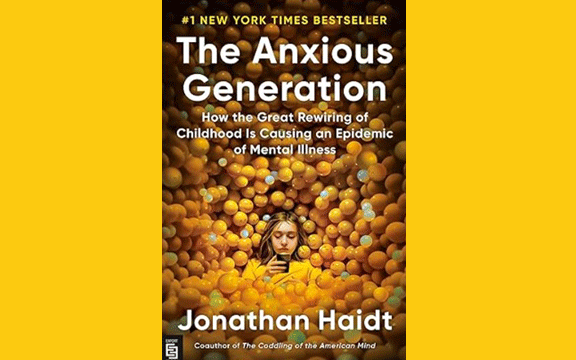
By Denise Bacon and Kathy Rowe
There is a reason why this book has remained at the top of the New York Times best seller list for over 52 weeks. In our opinion, this is a crucial and important book for our times. Parents, grandparents, educators, youth workers – anyone who engages with young people – please, read this book.
The title of the book belies the relatively easy read that the author has presented. Backed by several dozen fact-based studies, author and social psychologist Jonathan Haidt illustrates how and why the Smartphone has caused such a dramatic increase in depression, anxiety, self-harm and suicide among young people in many countries around the globe. He examines the detrimental effects of excessive screen time and social media use on the healthy development of young minds. In December of 2025, the government of Australia banned social media for minors under the age of 16. Jonathan Haidt had a lot to do with that ban.
Haidt lays the book out in four main sections (themes) containing chapters within. Each chapter ends cleverly with “In Sum” where he summarizes the important points made in each chapter. The book starts with a one-two punch as Haidt’s research clearly proves that a play-based childhood (up until the 1990’s) transitioned to a phone-based childhood (in the 2000’s). By 2010, the smartphone, along with high-speed internet, had begun to change the lives of most of us.
A play-based childhood is described as children and adolescents learning and developing in the real world through play. A phone-based childhood is described as children and adolescents learning and developing through the non-real virtual world. The author goes on to say that the generation born after 1995 (known as Gen Z) came into this world with easy access to the internet in their pockets.
Haidt explains, “The oldest members of Gen Z began puberty around 2009, when tech trends converged: the rapid spread of high-speed broadband in the 2000s, the arrival of the iPhone in 2007, and the rise of hyper-viral social media. Gen Z teens got sucked into spending many hours each day scrolling through posts of friends, acquaintances, and influencers. They spent far less time [interacting] friends and family, reducing participation in … social behaviours … essential for human development.”
Basically, access to the internet became portable with immediate accessibility through hand-held devices like phones. Instead of real friends and relationships that required nurturing, quarrels and problem resolution, debates and celebrations, teens developed online relationships which could be started and ended with a swipe.
Genuine appreciation of achievement was displaced with a “Like” on a post. Teens started measuring their own worth based on the number of “Likes” they received and on comparisons with posts of other teens who looked cooler and happier than themselves. Teens did not learn critical thinking, resilience, concentration, research or problem resolution. Haidt points to data that indicates a sharp increase in depressive episodes, especially among girls, which is linked to excessive consumption of social media via smartphones.
Girls and boys are wired differently, therefore Haidt explains to the reader how unsupervised heavy use access to social media, gaming and pornography has affected them differently. He highlights the irony and danger of parents’ over-supervision of real play compared with parents having no supervision over their children playing online, a much more dangerous environment.
Haidt’s chapter on the four foundational harms (Social deprivation, Sleep deprivation, attention fragmentation and addiction) is truly shocking.
Thankfully, Haidt claims that there is hope to change the course of the mental health crisis that society is experiencing. The creation and addiction to smartphones, social media and other online sites are collective problems, and were started by companies which quickly learned to monetize their users. Therefore, there needs to be an urgent collective response to this problem with all stakeholders doing their parts. Haidt proposes four key reforms: no smartphones before high school, no social media before age 16, phone-free schools, and more unsupervised real-life play.
Haidt states that adults must act together and lobby governments, policy makers, educators and communities. Finally, the tech companies that have created these addictive platforms have the ability to detect the ages of their users and they must be held accountable.
Bill Gates, co-founder of Microsoft, describes The Anxious Generation as “a must-read for anyone raising, working with, or teaching young people today,” adding that the book provides both “a wake-up call about where we’re headed” and “a roadmap for how we can change course.”